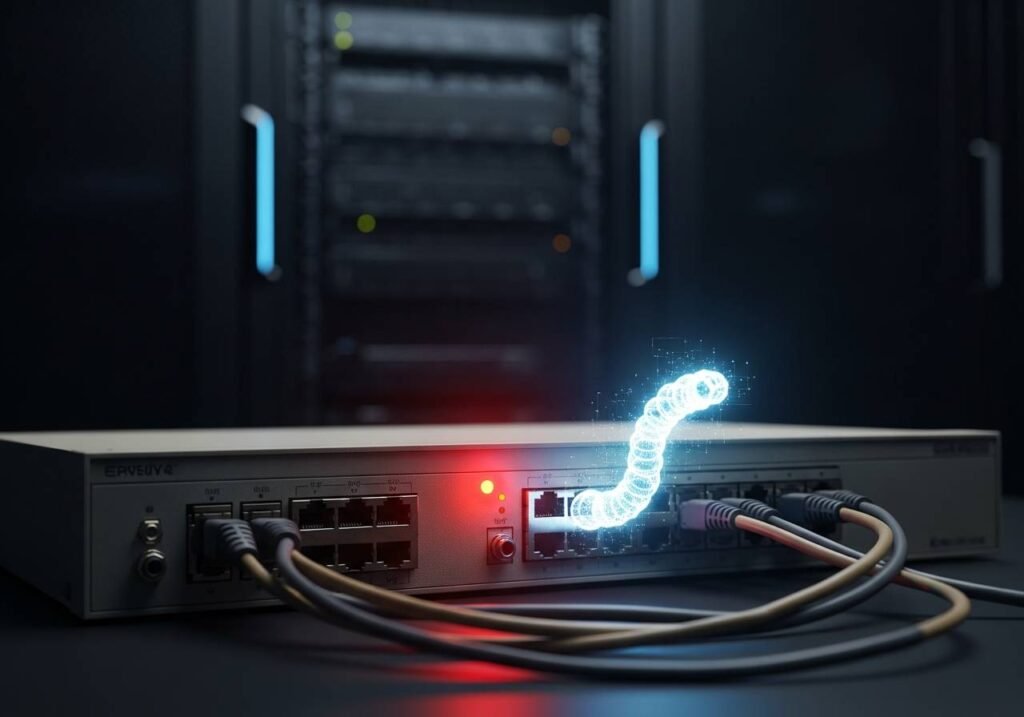
You’ve patched your servers. Your endpoints are secure. But there was that forgotten switch in the closet? The silent killer of Cybersecurity in the modern world is the legacy network devices. They leave you with a massive hole in your defense that is being exploited with great zeal by hackers at present. This isn’t a future threat. It’s a present danger.
The Hidden Hacking Surface in Your Walls
The contemporary vulnerability management is genius when it comes to identifying weaknesses in computers and programs. However, unfortunately, it can often entirely fail to touch the IT undercarriage. These are routers, switches and firewalls. These appliances are meant to be totally reliable. We put them up and, to tell the truth, we forget about them. They are incorporated into the plumbing of the building. Out of sight, out of mind.
This is the very issue of the set-it-and-forget-it attitude. Stability is a priority of network teams. Software vulnerabilities are scanned by security staff. The legacy equipment is in a perilous situation between these two priorities. No one is examining its expiration date.
The Playground of a Hacker
Why would you as an attacker take the trouble of attacking your well fortified servers, when you can even walk through the back door? A terminal network device is an invitation to death. The security patches have ceased being provided by the vendor. All the found flaws are never closed. It is a blessing to any threat actor.
Such machines are extremely powerful. Breaking into a core switch will enable an intruder to spy on all of your traffic. They are able to establish backdoors. Moreover, they can find the own trusted functions of the device, in order to move around. This renders it extremely hard to be detected by your AI-assisted security systems.
- “The unpatched firewall is not merely a vulnerability it is a tactical foothold on the part of an attacker.” – Top Network Architect with a fortune 500 company.
Case Study: Ivanti VPN Meltdown
We can consider a real life disaster. At the beginning of 2024, CISA made an emergency directive. It compelled the entire federal agencies to detach Ivanti VPN appliances. Why? Due to several emergency, zero-day vulnerabilities actively being deployed. Hackers sponsored by the state were intruding. They were stealing data and putting in place persistent backdoors.
A large number of organizations were fully exposed. They were unable to patch as fast as possible. Others were outdated versions which were no longer supported. This was not an imaginary danger. It was a disasterous breakdown of the perimeter. The very device which was supposed to offer secure remote access was the weakness.
The Budgetary Brick Wall
Why not simply upgrade this old equipment by the companies? The answer is rarely simple. The installation of a new enterprise firewall or core switch is a serious capital investment. It’s a tough sell to a CFO. You are requesting a huge amount of money to change something that, at least at the surface, seems to be literally performing well. No return on investment can be seen.
The fear of operations is worse still paralyzing. The replacement of a core network device is complicated. One wrong move can result in a complete crash of the network. This is the fear of IT leaders. The way of least resistance is to leave it to itself. This momentum is the friend of the attacker.
- We package security as being flashy and brand new AI tools, yet we dismiss the cracks and fissures in the foundation. It is as though a high-tech lock has been put on a door frame that is rotting away. – Chief Information Security Officer of a Financial Services Company.
Beyond Patching: A Realist Way Forward
You must have a multi-layered approach. You must find out what you have in the first place. Making a full network scan. You cannot safeguard what is out of your radar. Label each equipment with its end of support date. This establishes a definite and indisputable list of risk.
Next, you must prioritize. Your highest priority is to the internet-facing gadgets such as VPNs and firewalls. You must have compensating controls where the devices which cannot be immediately replaced are concerned. Isolate them onto a network VLAN. This holds the possible harm in case of subversion. Harden their arrangements violently. Shut off any unnecessary management services.
Your Artificial Intelligence is Blind to This menace
This is a crucial point. Your new AI security system could not save you. These systems are conditioned to attack patterns on servers and endpoints that are common. A hacker who carries out his attack on a router by altering an internal set of commands on an old router might be unseen. The anomaly is not calculable according to the AI model of normal traffic. Control of network infrastructure by human beings is more vital than ever.
Consider your network a castle. You may have the most secure guards ( Endpoint protection ) and the most secure gates (Firewalls ). Nevertheless, in the case of an overlooked, unprotected tunnel (a legacy switch) into the dungeon the castle is lost. Your other defenses will be as useless as ever.
A Final, Uncomfortable Truth
The unspoken legacy infrastructure crisis is an option. It is an act of choice to take a risk that one is aware of and that is increasing. Our priorities lie with visible, stylish security projects, rather than maintenance of the foundations. This must change.
After all, it is not whether or not you should upgrade that end-of-life device. The actual issue is whether you are able to bear the disastrous price of waiting to have it exploited. The clock is ticking. Get your ghosts before they are haunted.